Air Raid Precautions (ARP) were organised by the national
government and delivered by the local authorities. The aim was to protect
civilians from the danger of air-raids.
In September 1935, four years before WW2 began, British
prime minister, Stanley Baldwin, published a circular entitled Air Raid
Precautions (ARP) inviting local authorities to make plans to protect
their people in event of a war. Such plans included building public air
raid shelters. In April 1937 the government decided to create an Air Raid
Wardens' Service and during the next year recruited around 200,000 volunteers.
These volunteers were know as Air Raid Precaution Wardens.
What was the job of the ARP Wardens?
Their main purpose of ARP Wardens was to patrol the streets
during blackout and to ensure that no light was visible. If a light was
spotted, the warden would alert the person/people responsible by shouting
something like "Put that light out!" or "Cover that window!".
The ARP Wardens also reported the extent of bomb damage and assess the
local need for help from the emergency and rescue services. They were
responsible for the handing out of gas masks and pre-fabricated air-raid
shelters (such as Anderson shelters, as well as Morrison shelters), and
organised and staffed public air raid shelters. They used their knowledge
of their local areas to help find and reunite family members who had been
separated in the rush to find shelter from the bombs.There were 1.4 million
ARP wardens in Britain, most of who were part time volunteers who had
full time day jobs.
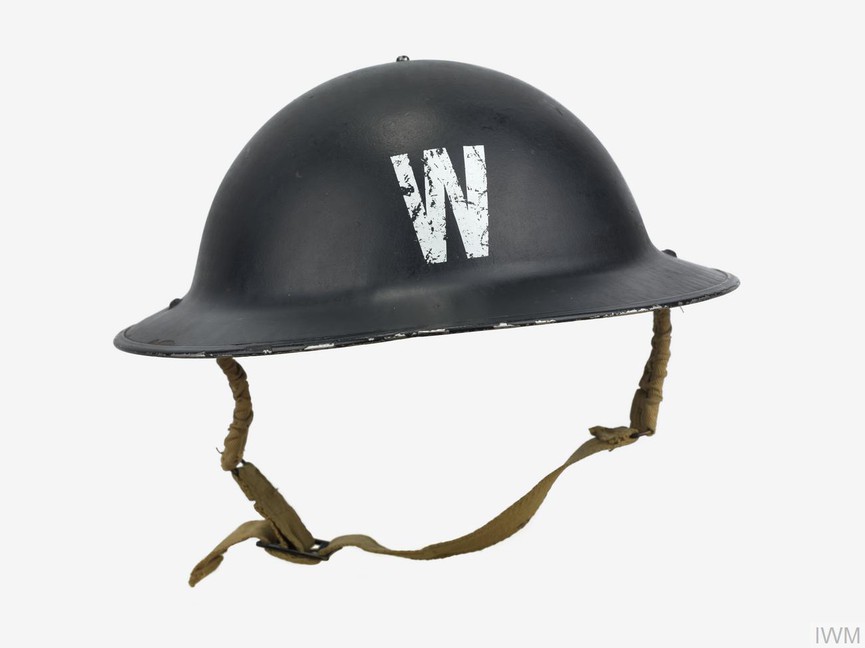 Air
raid wardens were issued with steel helmets with a large 'W' on the front.
These helmets were similar to the steel helmets issued to soldiers in
the First World War and protected the wearer from falling shrapnel or
debris. Steel helmets were also issued to firefighters, police officers
and other members of civil defence services, and soon became a recognisable
symbol of authority.
Air
raid wardens were issued with steel helmets with a large 'W' on the front.
These helmets were similar to the steel helmets issued to soldiers in
the First World War and protected the wearer from falling shrapnel or
debris. Steel helmets were also issued to firefighters, police officers
and other members of civil defence services, and soon became a recognisable
symbol of authority.


